Tap BPM Counter and Camelot Wheel
Tap BPM counter that also tells you when the number is good enough. Tap along with a song, and the range given with the BPM shows how far off it could still be.
Tap along with the beat.
Or press Space / Enter. A 2 second pause starts a new count.
Delay times in ms
| Note | Straight | Dotted | Triplet |
|---|
Your key, its relative key and its two neighbours
How many taps does it take to get the BPM right?
More than four. VirtualDJ's help says tapping 4 times "will accurately determine the correct BPM", while a Line 6 forum post says to tap at least 10 times. The range under the tempo reading settles it for your own taps. It is a 95% range, worked out from how far your taps scatter around a steady beat.
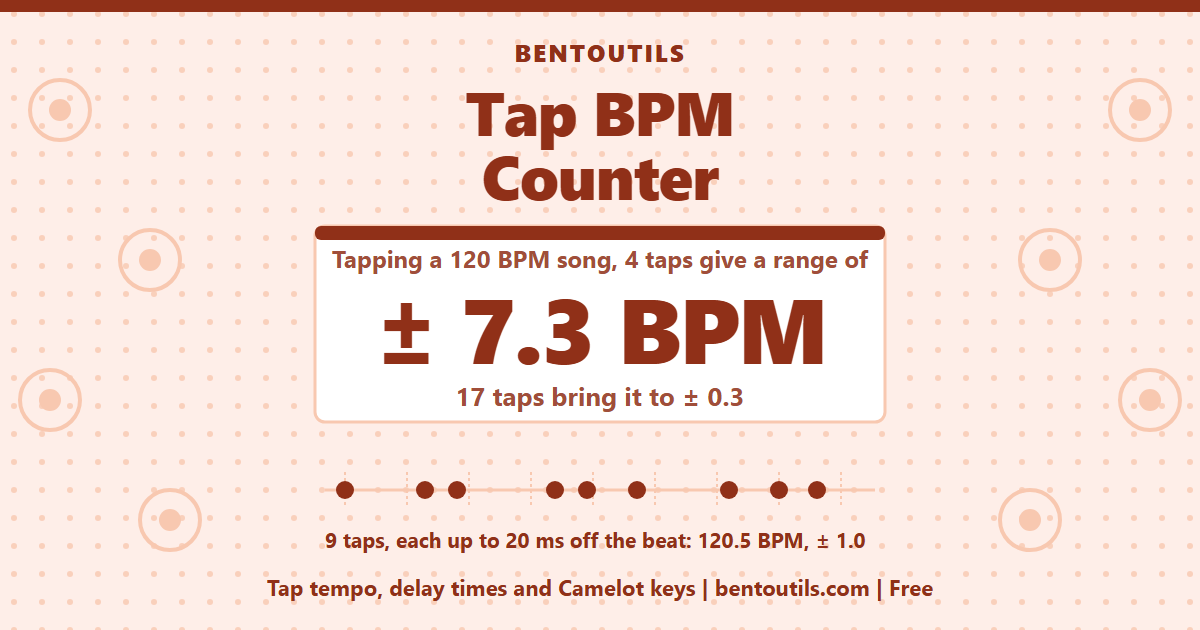
Here is one made-up run of taps at 120 BPM, each landing up to 20 ms early or late, put through the tool's own fit:
| Taps | Reading | 95% range |
|---|---|---|
| 4 | 119.2 BPM | ± 7.3 BPM |
| 9 | 120.5 BPM | ± 1.0 BPM |
| 17 | 120.1 BPM | ± 0.3 BPM |
In this run, going from 9 taps to 17 cut the range by more than three times, because every extra tap lengthens the span of time being measured. After the 9th tap the hint under the tempo reading said about 5 more taps for ± 0.5 BPM.
Why fit a line instead of averaging the gaps? Add up the gaps between taps and every middle tap cancels out, so a plain average is only the time from the first tap to the last, divided by the number of gaps. In a plain average the first and last taps decide the result, and badly timed first taps "will count", as the Line 6 post warns. The tool fits a straight line through every tap time, so the middle taps count too.
Use "Last 4 gaps" or "Last 8 gaps" when the tempo drifts. "All taps" usually gives the narrowest range when the track keeps a steady tempo.
How much does a steadier hand help?
Scaling the same made-up offsets models a steadier or a sloppier tapper keeping the beat. The table puts taps at 120 BPM through the tool's fit with each one landing up to 10, 20 or 40 ms off the beat, the 17 offsets repeating for the longer runs.
| Taps | Up to 10 ms off | Up to 20 ms off | Up to 40 ms off |
|---|---|---|---|
| 4 | ± 3.7 | ± 7.3 | ± 14.3 |
| 6 | ± 1.1 | ± 2.3 | ± 4.7 |
| 8 | ± 0.59 | ± 1.2 | ± 2.4 |
| 12 | ± 0.3 | ± 0.6 | ± 1.2 |
| 16 | ± 0.17 | ± 0.34 | ± 0.69 |
| 24 | ± 0.09 | ± 0.18 | ± 0.36 |
| 32 | ± 0.06 | ± 0.11 | ± 0.23 |
Halving the timing error roughly halves the range. Adding taps shrinks it faster: at 20 ms, doubling from 8 taps to 16 takes the range from ± 1.2 to ± 0.34 BPM.
The same slip costs more BPM at a faster tempo, because 20 ms is a bigger share of a short beat. With these 16 taps the range is ± 0.19 BPM at 90 BPM, ± 0.34 at 120, ± 0.47 at 140 and ± 0.73 at 174.
Is the song 87 or 174 BPM?
Both numbers can describe the same song. Tap on every beat and you get one tempo, tap on every other beat and you get half of it. DJ software gets this wrong too. One VirtualDJ user reported "a 80bpm song VDJ analysed it at 170bpm", roughly twice the tempo, and VirtualDJ's help points to its /2 and x2 buttons for a BPM that is half or double.
The tool shows half time and double time under the reading, so you can pick the figure that matches how the track is counted in your DJ library.
What BPM are house, techno and drum and bass?
Wikipedia's genre articles give a typical tempo for most dance styles. The last column is what the tool reads if you tap on every other beat, which is easy to do over half-time drums.
| Genre | Typical BPM | Tapped every other beat |
|---|---|---|
| House | 115 to 130 | 57.5 to 65 |
| Techno | 120 to 150 | 60 to 75 |
| Trance | 120 to 150 | 60 to 75 |
| Dubstep | 132 to 142 | 66 to 71 |
| Hardstyle | Around 150 (140 early on) | 75 (70) |
| Drum and bass | 165 to 185 | 82.5 to 92.5 |
The drum and bass article gives two ranges: 165 to 185 BPM in its opening and "usually between 160 and 180" in its tempo section, where it calls the mid-170s tempo "a hallmark" of the sound. Dubstep is "nearly always" 132 to 142 BPM with most releases at 140, so tapping along to its half-time snare reads a tempo near 70.
What delay time matches the tempo?
One beat lasts 60,000 ms divided by the BPM. Wikipedia's tempo article puts it the other way round: 60 BPM is one beat per second. The tool counts the beat as a quarter note, a dotted note as 1.5 times as long and a triplet as two thirds as long, and fills its delay table for whatever you tap or type. For common tempos:
| BPM | 1/4 | 1/8 | Dotted 1/8 | 1/8 triplet | 1/16 |
|---|---|---|---|---|---|
| 90 | 666.7 | 333.3 | 500 | 222.2 | 166.7 |
| 100 | 600 | 300 | 450 | 200 | 150 |
| 120 | 500 | 250 | 375 | 166.7 | 125 |
| 128 | 468.8 | 234.4 | 351.6 | 156.3 | 117.2 |
| 140 | 428.6 | 214.3 | 321.4 | 142.9 | 107.1 |
| 174 | 344.8 | 172.4 | 258.6 | 114.9 | 86.2 |
All values in milliseconds, rounded to 0.1 ms.
How long is each note from 60 to 180 BPM?
For a tempo the table above skips, here are straight notes every 10 BPM. A half note is two beats and a 1/32 note is an eighth of one.
| BPM | 1/2 | 1/4 | 1/8 | 1/16 | 1/32 |
|---|---|---|---|---|---|
| 60 | 2000 | 1000 | 500 | 250 | 125 |
| 70 | 1714.3 | 857.1 | 428.6 | 214.3 | 107.1 |
| 80 | 1500 | 750 | 375 | 187.5 | 93.8 |
| 90 | 1333.3 | 666.7 | 333.3 | 166.7 | 83.3 |
| 100 | 1200 | 600 | 300 | 150 | 75 |
| 110 | 1090.9 | 545.5 | 272.7 | 136.4 | 68.2 |
| 120 | 1000 | 500 | 250 | 125 | 62.5 |
| 130 | 923.1 | 461.5 | 230.8 | 115.4 | 57.7 |
| 140 | 857.1 | 428.6 | 214.3 | 107.1 | 53.6 |
| 150 | 800 | 400 | 200 | 100 | 50 |
| 160 | 750 | 375 | 187.5 | 93.8 | 46.9 |
| 170 | 705.9 | 352.9 | 176.5 | 88.2 | 44.1 |
| 180 | 666.7 | 333.3 | 166.7 | 83.3 | 41.7 |
Each note length is half the one to its left. At a tempo of 150 BPM the note lengths come out round: 400 ms a beat and 200 ms an eighth note.
How long are dotted and triplet notes?
A dotted note lasts 1.5 times as long as the straight one. A triplet fits three notes into the space of two, so each lasts two thirds as long.
| BPM | Dotted 1/4 | Dotted 1/8 | Dotted 1/16 | 1/4 triplet | 1/8 triplet |
|---|---|---|---|---|---|
| 60 | 1500 | 750 | 375 | 666.7 | 333.3 |
| 80 | 1125 | 562.5 | 281.3 | 500 | 250 |
| 90 | 1000 | 500 | 250 | 444.4 | 222.2 |
| 100 | 900 | 450 | 225 | 400 | 200 |
| 110 | 818.2 | 409.1 | 204.5 | 363.6 | 181.8 |
| 120 | 750 | 375 | 187.5 | 333.3 | 166.7 |
| 128 | 703.1 | 351.6 | 175.8 | 312.5 | 156.3 |
| 140 | 642.9 | 321.4 | 160.7 | 285.7 | 142.9 |
| 160 | 562.5 | 281.3 | 140.6 | 250 | 125 |
| 174 | 517.2 | 258.6 | 129.3 | 229.9 | 114.9 |
A dotted 1/8 is exactly three 1/16 notes. That is why it lands on 375 ms at 120 BPM, three times the 125 ms sixteenth.
Which Camelot code is my key?
Here is the whole wheel as Mixed In Key numbers it, with the 12 minor keys on the A ring and the 12 major keys on the B ring. Each row pairs a minor key with its relative key, which shares the same notes.
| Number | A ring (minor) | B ring (major) | Next numbers |
|---|---|---|---|
| 1 | 1A G♯ minor | 1B B major | 12 and 2 |
| 2 | 2A D♯ minor | 2B F♯ major | 1 and 3 |
| 3 | 3A B♭ minor | 3B D♭ major | 2 and 4 |
| 4 | 4A F minor | 4B A♭ major | 3 and 5 |
| 5 | 5A C minor | 5B E♭ major | 4 and 6 |
| 6 | 6A G minor | 6B B♭ major | 5 and 7 |
| 7 | 7A D minor | 7B F major | 6 and 8 |
| 8 | 8A A minor | 8B C major | 7 and 9 |
| 9 | 9A E minor | 9B G major | 8 and 10 |
| 10 | 10A B minor | 10B D major | 9 and 11 |
| 11 | 11A F♯ minor | 11B A major | 10 and 12 |
| 12 | 12A C♯ minor | 12B E major | 11 and 1 |
For a smooth blend, stay on your Camelot code, cross to the other ring at the same number, or step to a next number on your own Camelot ring. So 5A (C minor) mixes with 5B, 4A and 6A.
Your software may call 2A E♭ minor instead of D♯ minor. Both names are the same key, and the key box above accepts either spelling.
How far can you pitch a track before it changes key?
Change a track's playback speed and every frequency in it moves by the same ratio, as Wikipedia's article on time stretching explains. A semitone is a ratio of about 1.05946 (Wikipedia), so +5.95% on the pitch fader puts a track a full semitone sharp.
Matching a 124 BPM track to 128 BPM takes +3.23%, which is +0.55 semitone. That leaves the track 45 cents short of the next key, sitting between two keys. The same Wikipedia article notes that DJs commonly use pitch scaling to keep a track's pitch.
A whole semitone does move you round the Camelot wheel, but not by one number. Mixed In Key's Camelot page answers that question directly: one number is a move like 8A (A minor) to 9A (E minor), not a semitone. A semitone is 7 steps: A minor (8A) pitched up a semitone plays as B♭ minor, which Mixed In Key lists as 3A. Enter a key and the tempo of the next track above to see where yours lands.
For a blend without pitching, Mixed In Key suggests that from 8A you try 8A, 7A, 9A or 8B, and the wheel lights up the same three keys round yours. Earlier versions of this page numbered the wheel from C major as 1B. It now follows Mixed In Key, where 8A is A minor and 8B is C major.
How much pitch does it take to match two tempos?
These are common tempo gaps between two tracks, worked out like the 124 to 128 example above with key lock off. The last column is how far the track then sits from the nearest whole semitone, in cents (100 cents make a semitone).
| BPM | Pitch fader | Semitones | Cents off a whole key |
|---|---|---|---|
| 120 to 124 | +3.33% | +0.57 | 43 |
| 120 to 125 | +4.17% | +0.71 | 29 |
| 122 to 128 | +4.92% | +0.83 | 17 |
| 124 to 128 | +3.23% | +0.55 | 45 |
| 125 to 128 | +2.4% | +0.41 | 41 |
| 126 to 128 | +1.59% | +0.27 | 27 |
| 128 to 130 | +1.56% | +0.27 | 27 |
| 128 to 132 | +3.13% | +0.53 | 47 |
| 140 to 145 | +3.57% | +0.61 | 39 |
| 170 to 174 | +2.35% | +0.4 | 40 |
Only 122 to 128 BPM, at +4.92%, comes within 17 cents of a full semitone. Every other pair in the table leaves the track at least 27 cents from a whole semitone.
How far does a pitch fader reach?
The fader's range sets which tempos you can reach. The VirtualDJ manual for the AlphaTheta CDJ-3000X says its Tempo Range button cycles "through 6,10,16 and 100%", and Thomann lists the Technics SL-1200MK7 at ±8% or ±16%.
| Fader range | 120 BPM track | 128 BPM track | Full up, semitones | Full down, semitones |
|---|---|---|---|---|
| ± 6% | 112.8 to 127.2 | 120.3 to 135.7 | +1.01 | -1.07 |
| ± 8% | 110.4 to 129.6 | 117.8 to 138.2 | +1.33 | -1.44 |
| ± 10% | 108 to 132 | 115.2 to 140.8 | +1.65 | -1.82 |
| ± 16% | 100.8 to 139.2 | 107.5 to 148.5 | +2.57 | -3.02 |
Pitch follows the ratio of the speeds, so the same percentage moves a track further down than up: a ± 6% fader at full travel gives +1.01 semitones and -1.07. At the 100% setting a track can play twice as fast, 12 semitones (an octave) up.
Which tempo name fits 174 BPM?
The tool uses ten of the markings in Wikipedia's list, from Grave to Prestissimo, and their ranges overlap. In that set 174 BPM fits two: Vivace runs from 156 to 176 BPM and Presto from 168 to 200. The full list has more, such as Vivacissimo at 172 to 176. The tool shows every one of its ten whose range includes your tempo, so a 124 BPM track reads Allegro (120 to 156), and 120 BPM sits on the edge of both Moderato and Allegro.
Here are all ten tempo markings as the tool takes them from Wikipedia's list, with how long one beat lasts at each end of the range.
| Marking | BPM | One beat, ms |
|---|---|---|
| Grave | 24 to 40 | 2500 to 1500 |
| Largo | 40 to 66 | 1500 to 909.1 |
| Larghetto | 44 to 66 | 1363.6 to 909.1 |
| Adagio | 44 to 66 | 1363.6 to 909.1 |
| Andante | 56 to 108 | 1071.4 to 555.6 |
| Moderato | 108 to 120 | 555.6 to 500 |
| Allegro | 120 to 156 | 500 to 384.6 |
| Vivace | 156 to 176 | 384.6 to 340.9 |
| Presto | 168 to 200 | 357.1 to 300 |
| Prestissimo | 200 and over | 300 or less |
Larghetto and Adagio share one range, 44 to 66 BPM, so the tool always names those two tempo markings together with Largo, and from 56 BPM with Andante as well.
Wikipedia calls these figures "very rough approximations", so treat the tempo marking as a rough guide to the feel.
How this was checked
We ran this tool on cases that have a published answer and compared the results. Last checked October 2026.
| Case | Published | This tool | Source |
|---|---|---|---|
| BPM for taps one second apart | 60 BPM | 60 BPM | en.wikipedia.org |
| Speed ratio for one semitone | 1.05946 | 1.05946 | en.wikipedia.org |
| Camelot number of A minor (8A) | 8 | 8 | mixedinkey.com |
| Camelot number of C major (8B) | 8 | 8 | mixedinkey.com |
| Camelot number of G sharp minor (1A) | 1 | 1 | mixedinkey.com |
| Camelot number of C minor (5A) | 5 | 5 | mixedinkey.com |
| Camelot number of E major (12B) | 12 | 12 | mixedinkey.com |
| Lowest BPM Wikipedia lists for Allegro | 120 BPM | 120 BPM | en.wikipedia.org |
Corrections
- : Camelot numbers now follow Mixed In Key's wheel. Every code was 7 positions out: A minor showed as 1A and is 8A, C major showed as 1B and is 8B
How we research and check our tools. Spotted a mistake? Use the Report a bug button on this page.
Link to this tool
Sharing or citing this calculator? Copy a link in the format you need. You're free to quote and cite anything on this page.
https://bentoutils.com/apps/tap-bpm-counter/<a href="https://bentoutils.com/apps/tap-bpm-counter/">Tap BPM Counter and Camelot Wheel</a>[Tap BPM Counter and Camelot Wheel](https://bentoutils.com/apps/tap-bpm-counter/)<a href="https://bentoutils.com/apps/tap-bpm-counter/"><img src="https://bentoutils.com/public/og/tap-bpm-counter-v1.png" alt="Tap BPM Counter and Camelot Wheel" width="600" height="315"></a>Tap BPM Counter and Camelot Wheel. BentoUtils. November 2, 2026. https://bentoutils.com/apps/tap-bpm-counter/