Ring Size Chart and Converter
Ring size chart for US, UK, Japanese, EU and Swiss sizes, each worked out in millimetres from that system's own rule, so you can see where the usual charts disagree.
Ring size chart in mm
Each row is a US half size. The other columns give the nearest size in each system by its own rule. A dash means that scale ends before this size. Tap a row to load it into the converter.
UK and Japan are sourced in the sections below. EU is the circumference rounded to a whole millimetre, and Swiss is the circumference minus 40, as Wikipedia gives it.
| US | UK | Japan | EU | Swiss | Circumference (mm) | Diameter (mm) |
|---|---|---|---|---|---|---|
| 3 | F½ | 4 | 44 | 4.2 | 44.2 | 14.07 |
| 3.5 | G½ | 5 | 45 | 5.5 | 45.5 | 14.48 |
| 4 | H½ | 7 | 47 | 6.8 | 46.8 | 14.88 |
| 4.5 | I½ | 8 | 48 | 8.0 | 48.0 | 15.29 |
| 5 | J½ | 9 | 49 | 9.3 | 49.3 | 15.70 |
| 5.5 | K½ | 10 | 51 | 10.6 | 50.6 | 16.10 |
| 6 | L½ | 12 | 52 | 11.9 | 51.9 | 16.51 |
| 6.5 | M½ | 13 | 53 | 13.1 | 53.1 | 16.92 |
| 7 | N½ | 14 | 54 | 14.4 | 54.4 | 17.32 |
| 7.5 | O½ | 15 | 56 | 15.7 | 55.7 | 17.73 |
| 8 | P½ | 16 | 57 | 17.0 | 57.0 | 18.14 |
| 8.5 | Q½ | 18 | 58 | 18.3 | 58.3 | 18.54 |
| 9 | R½ | 19 | 60 | 19.5 | 59.5 | 18.95 |
| 9.5 | S½ | 20 | 61 | 20.8 | 60.8 | 19.35 |
| 10 | T½ | 21 | 62 | 22.1 | 62.1 | 19.76 |
| 10.5 | U½ | 23 | 63 | 23.4 | 63.4 | 20.17 |
| 11 | V½ | 24 | 65 | 24.6 | 64.6 | 20.57 |
| 11.5 | W½ | 25 | 66 | 25.9 | 65.9 | 20.98 |
| 12 | Y | 26 | 67 | 27.2 | 67.2 | 21.39 |
| 12.5 | Z | 27 | 68 | 28.5 | 68.5 | 21.79 |
| 13 | - | 29 | 70 | 29.7 | 69.7 | 22.20 |
| 13.5 | - | 30 | 71 | 31.0 | 71.0 | 22.61 |
| 14 | - | - | 72 | 32.3 | 72.3 | 23.01 |
| 14.5 | - | - | 74 | 33.6 | 73.6 | 23.42 |
| 15 | - | - | 75 | 34.8 | 74.8 | 23.83 |
What about sizes below US 3 or above US 15?
The US rule runs from size 0 to 16, and this converter takes the whole range. These are the rows the chart above leaves out, worked out the same way.
| US | UK | Japan | EU | Circumference (mm) | Diameter (mm) |
|---|---|---|---|---|---|
| 0 | below A | below 1 | 37 | 36.5 | 11.63 |
| 0.5 | A½ | below 1 | 38 | 37.8 | 12.04 |
| 1 | B½ | below 1 | 39 | 39.1 | 12.45 |
| 1.5 | C½ | 1 | 40 | 40.4 | 12.85 |
| 2 | D½ | 2 | 42 | 41.7 | 13.26 |
| 2.5 | E½ | 3 | 43 | 42.9 | 13.67 |
| 15.5 | past Z½ | past 30 | 76 | 76.1 | 24.23 |
| 16 | past Z½ | past 30 | 77 | 77.4 | 24.64 |
A US 0 is 36.55 mm round, smaller than UK A (37.5 mm) and Japan 1 (40.84 mm). On the Swiss scale it is -3.5, because Swiss sizes go below zero for rings under 40 mm round.
Convert a size or a measurement
How to measure your ring size at home
- Cut a thin strip of paper about 15 cm long.
- Wrap it snugly around the base of the finger you want to size. Don't pull it so tight that a ring couldn't slide over your knuckle.
- Use a pen to mark where the paper overlaps.
- Lay the paper flat and measure the distance from the end to your mark with a ruler. That is your circumference in mm.
- Enter the measurement below.
Nearest size in each system
Under US, UK and Japan: that size's own circumference, and how far it is from the size you entered.
What is a US 10 in Japanese sizes?
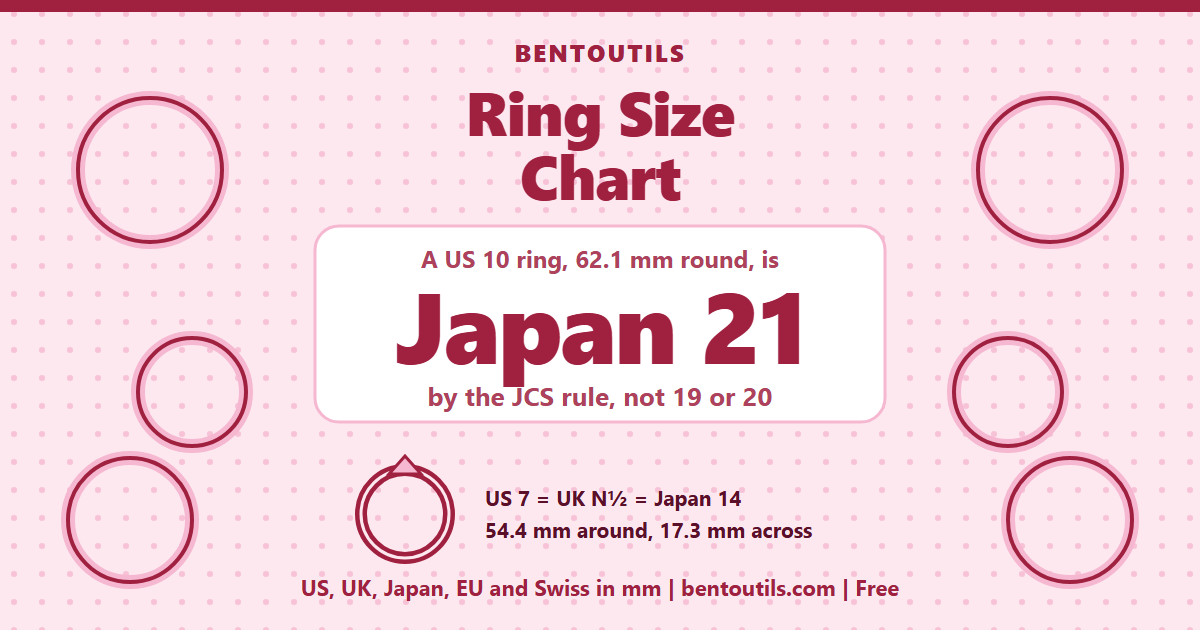
By the Japanese JCS rule, a US 10 is a 21. PriceScope, Blue Nile and Wikipedia print 20, and Daniel Wellington prints 19. They disagree because the charts and the rule step at different rates.
The ring sizes commonly used in Japan follow the JCS rule, which is based on the inside diameter, according to the Japanese converter site luft.co.jp. Its formula starts size 1 at 13.0 mm across and adds a third of a millimetre per size. The wedding site mwed.jp prints a JCS table that follows it: size 1 is 13.0 mm across and 40.8 mm round, and size 21 is 61.8 mm round.
A US 10 is 19.76 mm across and 62.08 mm round, from the US rule of 0.458 inch at size 0 plus 0.032 inch per size. Japan 21 is 61.78 mm round, 0.30 mm smaller. Japan 20 is 60.74 mm, 1.34 mm smaller, and Japan 19 is 59.69 mm, 2.39 mm smaller. A US half size is 1.28 mm round, so a 19 is almost two US half sizes small.
| US size | Daniel Wellington | PriceScope | Blue Nile | Wikipedia | JCS rule |
|---|---|---|---|---|---|
| 7 (54.42 mm) | 13 | 14 | 14 | 14 | 14 (54.45 mm) |
| 10 (62.08 mm) | 19 | 20 | 20 | 20 | 21 (61.78 mm) |
| 13 (69.74 mm) | 25 | no row | 27 | 27 | 29 (70.16 mm) |
Sources for the table: Daniel Wellington's chart, PriceScope's chart as archived in September 2025 (it stops at US 12), Blue Nile's printable chart and Wikipedia's equivalency table.
Daniel Wellington's chart adds one Japanese size for each US half size: 7 at US 4, 13 at US 7, 19 at US 10 and 25 at US 13. A Japanese size is only 1.05 mm round, against 1.28 mm for a US half size. The chart starts 0.36 mm large, with Japan 7 at 47.12 mm against 46.76 mm for a US 4. Over the next 18 steps the US sizes grow 22.98 mm and the Japanese sizes 18.85 mm, so the chart loses 4.13 mm and ends 3.77 mm small at US 13.
The other charts drift the same way, more slowly. Wikipedia's table puts US 13 at Japan 27, which the JCS rule makes 68.07 mm, 1.67 mm under the US size. Wikipedia also says Japanese sizes have no linear relation to diameter or circumference, while luft.co.jp and mwed.jp step a third of a millimetre per size. If you buy from a Japanese shop, ask for the ring's inside diameter in mm and enter it in the Ring diameter tab.
A guide on kiwisizing.com adds a different mix-up: it says each Japanese number is the circumference in mm. According to luft.co.jp, numbering by the circumference in mm is a different notation, JIS, where sizes read 41, 42 and so on.
Is a US 7 a UK N or N½?
N½. Daniel Wellington's chart says N, and so did this page until October 2026.
Wikipedia reports that in 1987 BSI moved UK letters to millimetres: each letter is 1.25 mm of circumference, size C is 40 mm round, and there are half sizes between letters. It cites BS 6820:1987, which BSI's catalogue lists as withdrawn on 15 March 1993. UK charts still print the letters.
On that rule N is 53.75 mm and N½ is 54.38 mm. A US 7 is 54.42 mm, so N½ is 0.05 mm away and N is 0.67 mm small, about half a UK size. PriceScope and Blue Nile also print N½ for a US 7.
A chart that gives every US half size the next letter drifts, because a letter is 1.25 mm and a US half size is 1.28 mm. This page's old chart did that, from F at US 3 to Z at US 13.
By the rule a US 3 is F½, which is where Blue Nile's printable chart starts too. A US 13 is past Z½: Z is 68.75 mm, 0.99 mm under it, and Z½ is 69.38 mm, 0.37 mm under it. Wikipedia's table prints Z½ for a US 13. This converter stops at Z½ and shows millimetres for anything larger.
What ring size is my measurement in mm?
On the US rule a ring is 36.55 mm round at size 0 and grows 2.55 mm per whole size. So the US size is the circumference in mm minus 36.55, divided by 2.55.
Take a 60 mm paper strip. That works out to US 9.18, and the nearest quarter size is 9.25 (60.17 mm). The same 60 mm is exactly UK S, Japan 19 (59.69 mm) and EU 60.
From 46 to 60 mm
Each row is a whole millimetre measured around the finger. The EU size is the same number as the millimetres, so it has no column of its own.
| Circumference (mm) | Exact US | Nearest US | UK | Japan |
|---|---|---|---|---|
| 46 | 3.70 | 3.75 | H | 6 |
| 47 | 4.09 | 4 | H½ | 7 |
| 48 | 4.49 | 4.5 | I½ | 8 |
| 49 | 4.88 | 5 | J | 9 |
| 50 | 5.27 | 5.25 | K | 10 |
| 51 | 5.66 | 5.75 | L | 11 |
| 52 | 6.05 | 6 | L½ | 12 |
| 53 | 6.44 | 6.5 | M½ | 13 |
| 54 | 6.84 | 6.75 | N | 14 |
| 55 | 7.23 | 7.25 | O | 15 |
| 56 | 7.62 | 7.5 | P | 15 |
| 57 | 8.01 | 8 | P½ | 16 |
| 58 | 8.40 | 8.5 | Q½ | 17 |
| 59 | 8.79 | 8.75 | R | 18 |
| 60 | 9.18 | 9.25 | S | 19 |
Both 55 and 56 mm come out as Japan 15. A Japanese size spans 1.05 mm, so now and then two whole millimetres share one.
From 61 to 75 mm
Larger hands run off the end of two scales. UK letters stop after Z½ and Japanese sizes after 30.
| Circumference (mm) | Exact US | Nearest US | UK | Japan |
|---|---|---|---|---|
| 61 | 9.58 | 9.5 | T | 20 |
| 62 | 9.97 | 10 | T½ | 21 |
| 63 | 10.36 | 10.25 | U½ | 22 |
| 64 | 10.75 | 10.75 | V | 23 |
| 65 | 11.14 | 11.25 | W | 24 |
| 66 | 11.53 | 11.5 | X | 25 |
| 67 | 11.93 | 12 | X½ | 26 |
| 68 | 12.32 | 12.25 | Y½ | 27 |
| 69 | 12.71 | 12.75 | Z | 28 |
| 70 | 13.10 | 13 | past Z½ | 29 |
| 71 | 13.49 | 13.5 | past Z½ | 30 |
| 72 | 13.88 | 14 | past Z½ | past 30 |
| 73 | 14.28 | 14.25 | past Z½ | past 30 |
| 74 | 14.67 | 14.75 | past Z½ | past 30 |
| 75 | 15.06 | 15 | past Z½ | past 30 |
From 70 mm a UK shop has no letter to offer, and from 72 mm a Japanese shop has no number. For those, give the seller the circumference in mm.
What are US ring sizes in inches?
The US rule is written in inches: 0.458 inch across the inside at size 0, plus 0.032 inch per whole size. This table gives the inside diameter and inside circumference in inches for each whole US size.
| US size | Diameter (in) | Circumference (in) |
|---|---|---|
| 3 | 0.554 | 1.740 |
| 4 | 0.586 | 1.841 |
| 5 | 0.618 | 1.942 |
| 6 | 0.650 | 2.042 |
| 7 | 0.682 | 2.143 |
| 8 | 0.714 | 2.243 |
| 9 | 0.746 | 2.344 |
| 10 | 0.778 | 2.444 |
| 11 | 0.810 | 2.545 |
| 12 | 0.842 | 2.645 |
| 13 | 0.874 | 2.746 |
| 14 | 0.906 | 2.846 |
| 15 | 0.938 | 2.947 |
A US half size adds 0.016 inch to the diameter and 0.050 inch to the circumference. At the ends of the scale, US 0 is 0.458 inch across and US 16 is 0.970 inch.
What is the most common ring size for women and men?
Robinson's Jewelers says its most commonly sold women's size is 6, with 5 through 7 also popular, and that men most often buy a 9, with 8 through 10 also common.
Foreverings, looking at a year of its own ring orders, puts women at a 7, with most between 6 and 8.5, and men at a 10, with most between 9 and 12.
So the two shops are one US size apart for both women and men. By the US rule a 6 is 51.87 mm round and a 7 is 54.42 mm; a 9 is 59.53 mm and a 10 is 62.08 mm. Both are sales figures from a single shop, so for a gift a measured ring beats either one.
How far off can a ring size be?
In 1921 the US Bureau of Standards could find no printed statement of what each US size should measure, according to its Circular 43. Gauges in shops in one area gave size 13 as anything from 0.870 to 0.878 inch across. Today's rule gives 0.874 inch, in the middle. That 0.008 inch spread is 0.64 mm round, half of a US half size.
The same circular notes that some companies read a ring at its top edge on the gauge, some at the middle and some at the lower edge, and that for broad rings this changes the reading by "an appreciable part of a size".
How much bigger should a wide band be?
Retailers still differ on how much to allow for width. Blue Nile suggests half a size up for wide styles, PriceScope a quarter or half size, and Misahara a full size for stackable rings.
Four guides tie the advice to a band width in mm. Quince and BlueStone call bands under 4 mm true to size, and The British Craft House sizes up only past 4 mm. Here is what each says for a 3 mm, 5 mm and 8 mm band.
| Guide | 3 mm | 5 mm | 8 mm |
|---|---|---|---|
| Quince | same size | +½ size | +1 size |
| BlueStone | same size | +½ size | +1 size |
| The British Craft House | same size | +½ size | +1 size |
| ECI Jewelers | not stated | not stated | +¼ or ½ |
At exactly 6 mm they split. BlueStone says a full size, The British Craft House says half (its full size starts at 7 mm), and Quince lists 6 mm in both its half-size and full-size bands.
In mm, a US half size is 1.28 mm of circumference and a full size 2.55 mm. The British Craft House works in UK letters, where its half size (M to M½) is 0.625 mm.
When should you measure, and what if you land between sizes?
Retailers also differ on when to measure. Blue Nile and PriceScope say the end of the day, when fingers are larger. Elaine B Jewelry says late morning or early afternoon is a more balanced time. Both Elaine B and Blue Nile say that if you land between two sizes, you should take the larger one.
Say a paper strip reads 56.0 mm. The converter puts that between US 7.5 (55.7 mm) and US 7.75 (56.3 mm) and suggests 7.75. The same strip is UK P, Japan 15 and EU 56.
How this was checked
We ran this tool on cases that have a published answer and compared the results. Last checked October 2026.
| Case | Published | This tool | Source |
|---|---|---|---|
| US size 7, inside circumference | 54.4 mm | 54.4 mm | en.wikipedia.org |
| US size 7, inside diameter | 17.32 mm | 17.32 mm | en.wikipedia.org |
| US size 0, inside diameter | 0.458 in | 0.458 in | luft.co.jp |
| UK size C, inside circumference | 40 mm | 40 mm | en.wikipedia.org |
| Japan size 1 (JCS), inside diameter | 13.0 mm | 13.0 mm | mwed.jp |
| Japan size 21 (JCS), inside circumference | 61.8 mm | 61.8 mm | mwed.jp |
| Swiss size 10, inside circumference | 50 mm | 50 mm | en.wikipedia.org |
Corrections
- : UK sizes now follow the 1.25 mm letter rule: US 7 gives N½, it gave N, and US 3 gives F½, it gave F
- : Japanese sizes now follow the JCS rule: US 10 gives 21, it gave 22, and US 13 gives 29, it gave 30
- : EU sizes now round the exact circumference: US 3.5 gives 45, it gave 46
How we research and check our tools. Spotted a mistake? Use the Report a bug button on this page.
Link to this tool
Sharing or citing this calculator? Copy a link in the format you need. You're free to quote and cite anything on this page.
https://bentoutils.com/apps/ring-size-chart/<a href="https://bentoutils.com/apps/ring-size-chart/">Ring Size Chart and Converter</a>[Ring Size Chart and Converter](https://bentoutils.com/apps/ring-size-chart/)<a href="https://bentoutils.com/apps/ring-size-chart/"><img src="https://bentoutils.com/public/og/ring-size-chart-v2.png" alt="Ring Size Chart and Converter" width="600" height="315"></a>Ring Size Chart and Converter. BentoUtils. November 2, 2026. https://bentoutils.com/apps/ring-size-chart/