Knots to mph and Nautical Unit Converter
Knots to mph, with the Beaufort force and the sea the Met Office expects for each wind speed. Nautical miles, depths and pressures convert here too.
Knots to mph chart, with the Beaufort force
Each row is a whole knot, with the speed in mph, km/h and metres per second. The force column is the Met Office Beaufort force for a wind of that speed, and the Beaufort table further down says what sea each force brings.
What is 1 to 16 knots in mph?
These are force 1 to force 4 winds, from light air to a moderate breeze.
| Knots | mph | km/h | m/s | Force |
|---|---|---|---|---|
| 1 | 1.2 | 1.9 | 0.5 | 1 |
| 2 | 2.3 | 3.7 | 1.0 | 1 |
| 3 | 3.5 | 5.6 | 1.5 | 1 |
| 4 | 4.6 | 7.4 | 2.1 | 2 |
| 5 | 5.8 | 9.3 | 2.6 | 2 |
| 6 | 6.9 | 11.1 | 3.1 | 2 |
| 7 | 8.1 | 13.0 | 3.6 | 3 |
| 8 | 9.2 | 14.8 | 4.1 | 3 |
| 9 | 10.4 | 16.7 | 4.6 | 3 |
| 10 | 11.5 | 18.5 | 5.1 | 3 |
| 11 | 12.7 | 20.4 | 5.7 | 4 |
| 12 | 13.8 | 22.2 | 6.2 | 4 |
| 13 | 15.0 | 24.1 | 6.7 | 4 |
| 14 | 16.1 | 25.9 | 7.2 | 4 |
| 15 | 17.3 | 27.8 | 7.7 | 4 |
| 16 | 18.4 | 29.6 | 8.2 | 4 |
10 knots is 11.5 mph, and 16 knots, the top of force 4, is 18.4 mph.
What is 17 to 33 knots in mph?
Force 5 starts at 17 knots, and force 7, a near gale, ends at 33.
| Knots | mph | km/h | m/s | Force |
|---|---|---|---|---|
| 17 | 19.6 | 31.5 | 8.7 | 5 |
| 18 | 20.7 | 33.3 | 9.3 | 5 |
| 19 | 21.9 | 35.2 | 9.8 | 5 |
| 20 | 23.0 | 37.0 | 10.3 | 5 |
| 21 | 24.2 | 38.9 | 10.8 | 5 |
| 22 | 25.3 | 40.7 | 11.3 | 6 |
| 23 | 26.5 | 42.6 | 11.8 | 6 |
| 24 | 27.6 | 44.4 | 12.3 | 6 |
| 25 | 28.8 | 46.3 | 12.9 | 6 |
| 26 | 29.9 | 48.2 | 13.4 | 6 |
| 27 | 31.1 | 50.0 | 13.9 | 6 |
| 28 | 32.2 | 51.9 | 14.4 | 7 |
| 29 | 33.4 | 53.7 | 14.9 | 7 |
| 30 | 34.5 | 55.6 | 15.4 | 7 |
| 31 | 35.7 | 57.4 | 15.9 | 7 |
| 32 | 36.8 | 59.3 | 16.5 | 7 |
| 33 | 38.0 | 61.1 | 17.0 | 7 |
19 knots is 21.9 mph, and 25 knots is 28.8 mph.
What is 34 to 50 knots in mph?
A gale, force 8, starts at 34 knots, which is 39.1 mph.
| Knots | mph | km/h | m/s | Force |
|---|---|---|---|---|
| 34 | 39.1 | 63.0 | 17.5 | 8 |
| 35 | 40.3 | 64.8 | 18.0 | 8 |
| 36 | 41.4 | 66.7 | 18.5 | 8 |
| 37 | 42.6 | 68.5 | 19.0 | 8 |
| 38 | 43.7 | 70.4 | 19.5 | 8 |
| 39 | 44.9 | 72.2 | 20.1 | 8 |
| 40 | 46.0 | 74.1 | 20.6 | 8 |
| 41 | 47.2 | 75.9 | 21.1 | 9 |
| 42 | 48.3 | 77.8 | 21.6 | 9 |
| 43 | 49.5 | 79.6 | 22.1 | 9 |
| 44 | 50.6 | 81.5 | 22.6 | 9 |
| 45 | 51.8 | 83.3 | 23.2 | 9 |
| 46 | 52.9 | 85.2 | 23.7 | 9 |
| 47 | 54.1 | 87.0 | 24.2 | 9 |
| 48 | 55.2 | 88.9 | 24.7 | 10 |
| 49 | 56.4 | 90.7 | 25.2 | 10 |
| 50 | 57.5 | 92.6 | 25.7 | 10 |
At 48 knots the wind reaches force 10, a storm, and 50 knots is 57.5 mph.
What are speeds above 50 knots in mph?
Every wind of 64 knots or more is force 12, hurricane, so this table has no force column. It works the same for a boat or an aircraft speed given in knots.
| Knots | mph | km/h | m/s |
|---|---|---|---|
| 55 | 63.3 | 101.9 | 28.3 |
| 60 | 69.0 | 111.1 | 30.9 |
| 64 | 73.6 | 118.5 | 32.9 |
| 70 | 80.6 | 129.6 | 36.0 |
| 75 | 86.3 | 138.9 | 38.6 |
| 80 | 92.1 | 148.2 | 41.2 |
| 85 | 97.8 | 157.4 | 43.7 |
| 90 | 103.6 | 166.7 | 46.3 |
| 100 | 115.1 | 185.2 | 51.4 |
| 110 | 126.6 | 203.7 | 56.6 |
| 115 | 132.3 | 213.0 | 59.2 |
| 120 | 138.1 | 222.2 | 61.7 |
| 140 | 161.1 | 259.3 | 72.0 |
| 150 | 172.6 | 277.8 | 77.2 |
115 knots is 132.3 mph, and 150 knots is 172.6 mph or 277.8 km/h.
Convert speed, distance, depth or pressure
Beaufort scale
Passage planner
Do you multiply or divide by 1.15?
Multiply knots by 1.15078 to get mph, and divide mph by the same conversion factor to get knots. A nautical mile is exactly 1,852 m and a mile is 1,609.344 m, so one knot is 1,852 / 1,609.344 = 1.150779 mph. The Met Office rounds that to 1.15, and NOAA gives a nautical mile as 1.1508 statute miles.
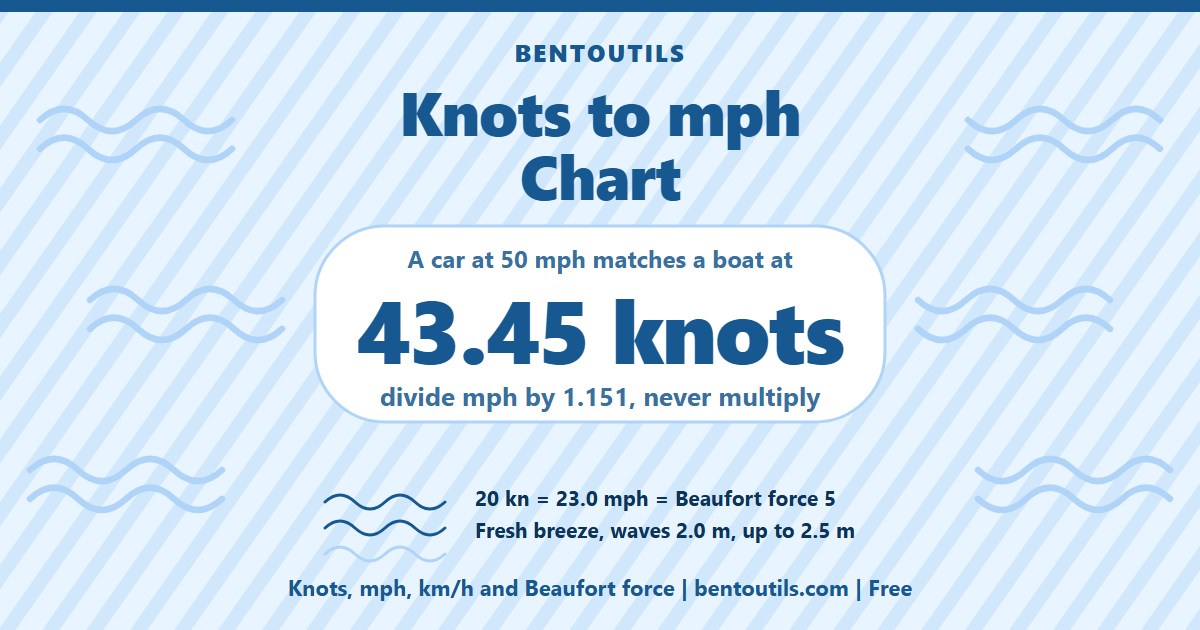
The direction is easy to get wrong. A guide to knots from the whale-watching company Harbor Breeze Cruises says a car at 50 mph matches a boat at about 57.55 knots. That is 50 times 1.151. Dividing gives a boat speed of 43.45 knots, and 57.55 knots is really 66.2 mph.
To turn mph into knots, divide by the conversion factor 1.15078. To turn km/h into knots, divide by 1.852, because a knot is exactly 1.852 km/h. Find your road speed or wind speed in the first column and read across.
| Speed | mph in knots | km/h in knots |
|---|---|---|
| 5 | 4.3 | 2.7 |
| 10 | 8.7 | 5.4 |
| 15 | 13.0 | 8.1 |
| 20 | 17.4 | 10.8 |
| 25 | 21.7 | 13.5 |
| 30 | 26.1 | 16.2 |
| 40 | 34.8 | 21.6 |
| 50 | 43.4 | 27.0 |
| 60 | 52.1 | 32.4 |
| 70 | 60.8 | 37.8 |
| 80 | 69.5 | 43.2 |
| 100 | 86.9 | 54.0 |
| 120 | 104.3 | 64.8 |
| 150 | 130.3 | 81.0 |
| 200 | 173.8 | 108.0 |
So 60 mph is 52.1 knots, and 100 km/h is 54.0 knots.
Nautical miles to miles uses the same number, because a knot is one nautical mile per hour: 20 nautical miles is 23.0 statute miles.
What does each Beaufort force mean in knots, mph and km/h?
The Met Office Beaufort scale gives each force in whole knots and metres per second, not in mph or km/h.
Force 5, a fresh breeze, is 17 to 21 knots on the Met Office Beaufort scale, which is 19.0 to 24.7 mph once speeds are rounded to the nearest whole knot. The converter rounds the wind speed to the nearest whole knot before it picks a force, so its force 5 runs from 16.5 knots up to 21.5 knots.
| Force | Knots | mph | km/h | Sea state | Probable waves |
|---|---|---|---|---|---|
| 0 Calm | below 1 | below 1.2 | below 1.9 | Calm (glassy) | Flat |
| 1 Light air | 1 to 3 | 1.2 to 4.0 | 1.9 to 6.5 | Calm (rippled) | 0.1 m |
| 2 Light breeze | 4 to 6 | 4.0 to 7.5 | 6.5 to 12.0 | Smooth (wavelets) | 0.2 m, up to 0.3 m |
| 3 Gentle breeze | 7 to 10 | 7.5 to 12.1 | 12.0 to 19.4 | Slight | 0.6 m, up to 1.0 m |
| 4 Moderate breeze | 11 to 16 | 12.1 to 19.0 | 19.4 to 30.6 | Slight to moderate | 1.0 m, up to 1.5 m |
| 5 Fresh breeze | 17 to 21 | 19.0 to 24.7 | 30.6 to 39.8 | Moderate | 2.0 m, up to 2.5 m |
| 6 Strong breeze | 22 to 27 | 24.7 to 31.6 | 39.8 to 50.9 | Rough | 3.0 m, up to 4.0 m |
| 7 Near gale | 28 to 33 | 31.6 to 38.6 | 50.9 to 62.0 | Rough to very rough | 4.0 m, up to 5.5 m |
| 8 Gale | 34 to 40 | 38.6 to 46.6 | 62.0 to 75.0 | Very rough to high | 5.5 m, up to 7.5 m |
| 9 Strong gale | 41 to 47 | 46.6 to 54.7 | 75.0 to 88.0 | High | 7.0 m, up to 10.0 m |
| 10 Storm | 48 to 55 | 54.7 to 63.9 | 88.0 to 102.8 | Very high | 9.0 m, up to 12.5 m |
| 11 Violent storm | 56 to 63 | 63.9 to 73.1 | 102.8 to 117.6 | Very high | 11.5 m, up to 16.0 m |
| 12 Hurricane | 64 or more | 73.1 or more | 117.6 or more | Phenomenal | 14 m or more |
Each mph and km/h wind speed range runs up to the start of the next force, so there is no gap between rows. The wave heights are for well-developed waves in the open sea, and the Met Office warns that the sea takes a while to build after the wind gets up.
How far is a nautical mile in km and miles?
A nautical mile is exactly 1,852 m, so kilometres are the nautical miles times 1.852 and come out exact. Statute miles use 1.15078, the same conversion factor as knots to mph.
What is 1 to 1,000 nautical miles in km and miles?
Read the kilometres and statute miles across from the distance in nautical miles.
| Nautical miles | km | Miles |
|---|---|---|
| 1 | 1.852 | 1.15 |
| 2 | 3.704 | 2.30 |
| 3 | 5.556 | 3.45 |
| 5 | 9.26 | 5.75 |
| 10 | 18.52 | 11.51 |
| 20 | 37.04 | 23.02 |
| 25 | 46.3 | 28.77 |
| 50 | 92.6 | 57.54 |
| 100 | 185.2 | 115.08 |
| 200 | 370.4 | 230.16 |
| 250 | 463 | 287.69 |
| 500 | 926 | 575.39 |
| 1,000 | 1,852 | 1,150.78 |
1,000 nautical miles is exactly 1,852 km, or 1,150.78 statute miles.
How many nautical miles is a distance in km or miles?
Divide kilometres by 1.852, or statute miles by 1.15078, to get nautical miles.
| Distance | km in nm | Miles in nm |
|---|---|---|
| 1 | 0.54 | 0.87 |
| 2 | 1.08 | 1.74 |
| 5 | 2.70 | 4.34 |
| 10 | 5.40 | 8.69 |
| 20 | 10.80 | 17.38 |
| 50 | 27.00 | 43.45 |
| 100 | 54.00 | 86.90 |
| 200 | 107.99 | 173.80 |
| 500 | 269.98 | 434.49 |
| 1,000 | 539.96 | 868.98 |
100 km is 54.00 nautical miles, and 100 statute miles is 86.90 nautical miles.
How long does a passage take at a given speed in knots?
Passage time is distance divided by boat speed, and because a knot is one nautical mile per hour the answer comes out in hours. 120 nautical miles at 7 knots is 17.14 hours, or 17 h 9 min, which is what the passage planner above shows when the page opens.
This table runs the same sum for a few distances in nautical miles and speeds in knots.
| Nautical miles | 5 kn | 6 kn | 7 kn | 8 kn | 10 kn |
|---|---|---|---|---|---|
| 10 | 2 h 0 min | 1 h 40 min | 1 h 26 min | 1 h 15 min | 1 h 0 min |
| 25 | 5 h 0 min | 4 h 10 min | 3 h 34 min | 3 h 8 min | 2 h 30 min |
| 50 | 10 h 0 min | 8 h 20 min | 7 h 9 min | 6 h 15 min | 5 h 0 min |
| 100 | 20 h 0 min | 16 h 40 min | 14 h 17 min | 12 h 30 min | 10 h 0 min |
| 120 | 24 h 0 min | 20 h 0 min | 17 h 9 min | 15 h 0 min | 12 h 0 min |
| 250 | 50 h 0 min | 41 h 40 min | 35 h 43 min | 31 h 15 min | 25 h 0 min |
| 500 | 100 h 0 min | 83 h 20 min | 71 h 26 min | 62 h 30 min | 50 h 0 min |
On 100 nautical miles, 6 knots instead of 5 saves 3 h 20 min of passage time.
Why is a ship's speed called a knot?
Sailors once measured speed with a chip log, a weighted board on a line thrown over the stern. According to Wikipedia, knots were tied in the line 47 feet 3 inches (14.4018 m) apart, and a sailor counted them as they ran out while another timed it with a sand-glass. Wikipedia gives a 30-second glass and says 28 seconds is the currently accepted timing.
With the 28-second glass the arithmetic works out. 47.25 ft in 28 seconds is 6,075 ft an hour, about a foot short of today's nautical mile of 6,076.12 ft, so one knot of line per glass meant one nautical mile per hour.
Was a knot always the same speed?
No. The nautical mile of exactly 1,852 m was agreed in 1929, but according to Wikipedia the United States didn't adopt it until 1954, and the UK used the Admiralty nautical mile of 6,080 ft until 1970.
An Admiralty knot is 6,080 / 5,280 = 1.1515 mph, 0.064% more than today's knot. A British speed of 20 knots from before 1970 is 23.03 mph rather than 23.02, a difference of 0.01 mph.
How deep is a fathom?
Six feet, or 1.8288 m, according to Wikipedia. The depth tab converts fathoms, feet, metres and centimetres. Pressure works the same way: 1,013.25 hPa is 29.92 inHg, with psi and inHg taken from NIST's conversion factors.
How this was checked
We ran this tool on cases that have a published answer and compared the results. Last checked October 2026.
| Case | Published | This tool | Source |
|---|---|---|---|
| 1 knot in mph | 1.15 mph | 1.15 mph | weather.metoffice.gov.uk |
| 1 knot in metres per second | 0.514 m/s | 0.514 m/s | weather.metoffice.gov.uk |
| 1 nautical mile in metres | 1852 m | 1852 m | en.wikipedia.org |
| 1 nautical mile in statute miles | 1.1508 mi | 1.1508 mi | oceanservice.noaa.gov |
| 1 fathom in metres | 1.8288 m | 1.8288 m | en.wikipedia.org |
| Beaufort force for a 21 knot wind | 5 | 5 | weather.metoffice.gov.uk |
| Beaufort force for a 34 knot wind | 8 | 8 | weather.metoffice.gov.uk |
Corrections
- : Beaufort sea states now follow the Met Office table. Force 7 read very rough and is rough to very rough, force 8 read high and is very rough to high, force 9 read very high and is high, and force 11 read phenomenal and is very high
How we research and check our tools. Spotted a mistake? Use the Report a bug button on this page.
Link to this tool
Sharing or citing this calculator? Copy a link in the format you need. You're free to quote and cite anything on this page.
https://bentoutils.com/apps/knots-to-mph-converter/<a href="https://bentoutils.com/apps/knots-to-mph-converter/">Knots to mph and Nautical Unit Converter</a>[Knots to mph and Nautical Unit Converter](https://bentoutils.com/apps/knots-to-mph-converter/)<a href="https://bentoutils.com/apps/knots-to-mph-converter/"><img src="https://bentoutils.com/public/og/knots-to-mph-converter-v1.png" alt="Knots to mph and Nautical Unit Converter" width="600" height="315"></a>Knots to mph and Nautical Unit Converter. BentoUtils. November 2, 2026. https://bentoutils.com/apps/knots-to-mph-converter/